
How to Store and Reconstitute Research Peptides: Bacteriostatic Water, Temperature, and Shelf Life

Research use only. All BodyTechPharma materials are supplied strictly for in-vitro laboratory and research use. They are not medicines, supplements or therapeutic goods, are not for human or animal consumption, and are not authorized by Health Canada for any clinical use. Nothing in this article is medical advice or guidance for use in or on a person or animal.
Short answer: Keep lyophilised (freeze-dried) peptide sealed, dry, dark and frozen. Bachem recommends storing the powder below −15 °C, with −50 °C or lower preferred for long-term storage (Bachem). Make a stock solution only when an experiment needs it, split it into single-use aliquots and freeze them, because peptides in solution degrade faster than the dry powder. There is no universal shelf life. Stability depends on the sequence, the solvent and the storage conditions, so check the supplier’s data for the specific lot.
Why are research peptides supplied lyophilised?
Water is the problem. In solution, peptides are exposed to the reactions that break them down, including hydrolysis of the backbone and changes to individual side chains. Bachem’s guidance is blunt: peptides “should not be stored in solution (even sterile and oxygen-free solution) because they may slowly undergo chemical degradation” (Bachem).
Freeze-drying removes most of that water and leaves a solid that holds up far better. Sigma-Aldrich calls storage in lyophilised form at −20 °C, or preferably −80 °C, “the most effective way to prevent or minimize peptide degradation” (Sigma-Aldrich).
The dry powder still needs protecting from moisture, heat, light and oxygen. The ICH Q5C stability guideline, published by the U.S. FDA, describes protein and polypeptide products as “particularly sensitive to environmental factors such as temperature changes, oxidation, light, ionic content, and shear” (FDA / ICH Q5C). That guideline was written for biotechnological products, not catalogue research peptides, but its list of stress factors is a useful checklist for any lab.
How should lyophilised peptides be stored?
Four conditions matter for storing research peptides: temperature, moisture, light and air.
Temperature. Bachem recommends a tightly closed container below −15 °C, with −50 °C or below preferred for long-term storage. It also notes that peptides may ship at room temperature and can sit in a 4 °C refrigerator for short-term use (Bachem). Sigma-Aldrich recommends −20 °C for short-term storage (1–2 weeks) and −80 °C for longer storage (Sigma-Aldrich). The two suppliers draw the line differently, so treat a standard −20 °C freezer as fine for working stock and use −80 °C for anything you plan to keep.
Moisture. Peptides tend to be hygroscopic. Bachem advises letting the closed container reach room temperature in a desiccator before opening it, weighing quickly and resealing tightly. Absorbed moisture “reduces the overall peptide content and may also decrease stability” (Bachem). Open a cold vial straight from the freezer and condensation forms on the powder.
Light. Store vials in the dark or in their outer packaging. Sigma-Aldrich advises storing away from bright light, and light is one of the stress factors named in ICH Q5C (Sigma-Aldrich; FDA / ICH Q5C).
Air. Sigma-Aldrich advises minimising prolonged exposure of lyophilised peptides and solutions to atmospheric oxygen (Sigma-Aldrich). This matters most for sequences containing Cys, Met or Trp, which Bachem flags as needing special care to avoid oxidation (Bachem).
What degrades peptides in storage?
The amino acid sequence is the main predictor of how a peptide will behave. Bachem lists Asn, Gln, Met, Cys and Trp as residues that limit shelf life, and Sigma-Aldrich describes peptides containing N, Q, C, M and W as unstable in solution (Bachem; Sigma-Aldrich). The chemistry behind this, including deamidation, oxidation and aggregation, is reviewed in Manning et al., which covers chemical and physical instability in solution and in the dried state (Manning et al., Pharm Res 2010; PMID 20143256).
| Residue or feature | Main risk | Handling response |
|---|---|---|
| Asn (N), Gln (Q) | Limited shelf life in solution (Bachem; Sigma-Aldrich); deamidation is the usual mechanism | Avoid long-term storage in solution; freeze aliquots |
| Met (M), Trp (W) | Oxidation (Bachem) | Oxygen-free water or buffer; limit air exposure |
| Cys (C), free thiol | Oxidation to disulfides, rapid above pH 7 (Bachem) | Dissolve in degassed acidic buffer; consider a reducing agent such as DTT if the assay allows |
| Hydrophobic sequences | Poor solubility, aggregation | Small volume of organic solvent first, then dilute (Bachem) |
| Any sequence at high pH | Faster degradation | Avoid prolonged exposure above pH 8; chill or freeze such solutions (Sigma-Aldrich) |
Sources for table: Bachem; Sigma-Aldrich; Manning et al. 2010.
How do you reconstitute a peptide for an assay?
In a lab, “reconstitution” means dissolving the lyophilised powder to make a stock solution at a known concentration, then diluting it into the assay. Bachem is clear about the limits of any general protocol: “As the properties of peptides can vary extraordinarily, we are unable to provide a standard protocol for dissolving a peptide” (Bachem). What follows are the decisions to make, not a recipe.
Bacteriostatic water vs sterile water: which diluent suits your assay?
Start from the assay, not the vial, when choosing a diluent for research peptides.
- Buffer (e.g., PBS, pH 7.0–7.4). Bachem calls PBS “the safest diluent” for many basic and acidic peptides when a concentration of 1 mg/mL or less is enough (Bachem). For solutions you intend to store, Sigma-Aldrich suggests sterile buffers at pH 5–6 (Sigma-Aldrich).
- Acidic or basic solvent first. Basic peptides may need a small amount of acetic acid; acidic peptides a small amount of 0.1% aqueous ammonia, followed by dilution with water (Bachem).
- Organic solvent for hydrophobic sequences. DMSO, DMF, acetonitrile and similar solvents, used in small amounts before dilution. Bachem warns that high concentrations of these solvents “are incompatible with biological systems such as cells” (Bachem).
- Bacteriostatic water. USP bacteriostatic water is sterile water containing benzyl alcohol as a preservative, 0.9% (9 mg/mL) or 1.1% (11 mg/mL) depending on the product, supplied in multiple-dose containers (DailyMed label, Hospira). The preservative limits microbial growth in a vial that is entered repeatedly. It does not make a peptide more chemically stable, and it brings its own chemistry into your experiment.
That last point matters for cell work. In a cultured-cell study, benzyl alcohol at 9 mg/mL (the 0.9% strength) was toxic to human and rabbit retinal pigment epithelial cells within five minutes, and 0.225 mg/mL impaired human cell function after two hours (Chang et al., Exp Eye Res 2008; PMID 18420195). That is one in-vitro model under specific conditions, but it is a good reason to run a vehicle control, or choose a preservative-free diluent, for any cell-based assay.
General technique
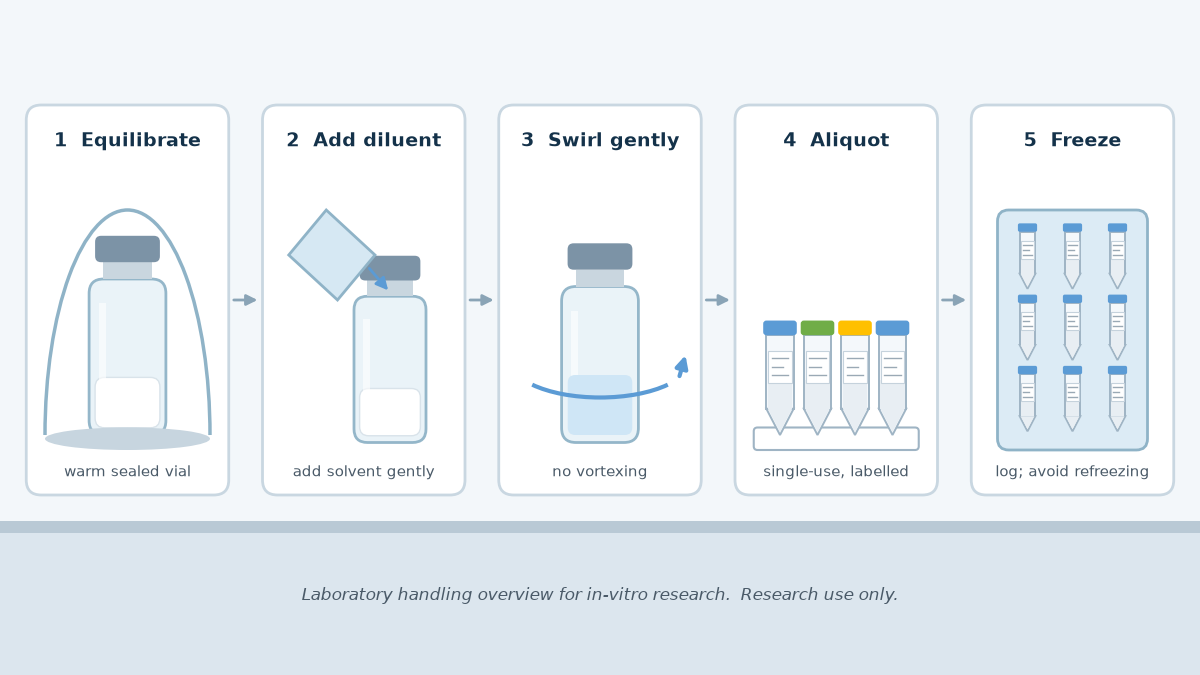
Work aseptically, in a biosafety cabinet where your protocol requires one. Add solvent gently and swirl rather than vortex. Vigorous agitation can drive aggregation in some proteins: in one study, intensive vortexing of insulin at 60 °C produced distinct aggregate structures (Loksztejn & Dzwolak, J Mol Biol 2010; PMID 19891974). That is a single protein under harsh conditions, and evidence for short peptides is thin, so treat gentle mixing as a precaution rather than a proven rule. Bachem notes that dissolving can take time, occasionally several hours, and that brief sonication in a water bath can help, while “excessive warming of the sample should be avoided” (Bachem). Inspect the solution: it should be clear, with no visible particles.
Calculate concentration (mg/mL) from net peptide content, not the gross weight of powder. Bachem explains that research peptides are often over 95% pure by HPLC, but the peptide content of the solid “may range from 70 to 90%” because of counter-ions and residual moisture (Bachem, Care and Handling of Peptides). Lot data for BodyTechPharma materials is on our Lab Results page.
Aliquoting and labelling
Divide the stock into single-use aliquots as soon as it is made. Bachem and Sigma-Aldrich both recommend aliquoting and freezing solutions, and Sigma-Aldrich specifically to avoid repeated freeze-thaw cycles (Bachem; Sigma-Aldrich). Label every tube with compound, lot number, solvent, concentration, preparation date and initials.
If your assay works at low concentrations, consider low-binding tubes. Peptides can stick to container walls: in an LC-MS study of 50 model peptides, standard polypropylene tubes and vials lost adsorption-prone peptides over time, while low-binding modified polypropylene kept recovery above 80% over 24 hours (Zhang et al., Se Pu 2022; PMID 35791600).
How long are peptides stable after reconstitution?
There is no single number. Bachem says frozen solutions “may be kept for a few weeks” and that long-term storage of peptide solutions is not recommended, especially for sequences with Asn, Gln, Cys, Met or Trp (Bachem). Sigma-Aldrich gives up to a week at 4 °C as a general figure, and suggests freezing sequences with known instability (Sigma-Aldrich). Anything beyond that needs compound-specific stability data.
Where does the “28-day” figure come from?
You will see “use within 28 days” repeated online as if it were peptide stability data. It is not. It comes from sterility rules for opened multi-dose vials in clinical settings. The Joint Commission says an opened or accessed vial should be discarded within 28 days unless the manufacturer specifies a different date (Joint Commission). That rule is about microbial contamination of the vial. It says nothing about whether a given peptide sequence is still intact after 28 days in solution.
The principle in ICH Q5C is the one to borrow: storage periods are set from stability testing of the specific product (FDA / ICH Q5C). If your work depends on long storage, test it with HPLC or MS against a fresh reference.
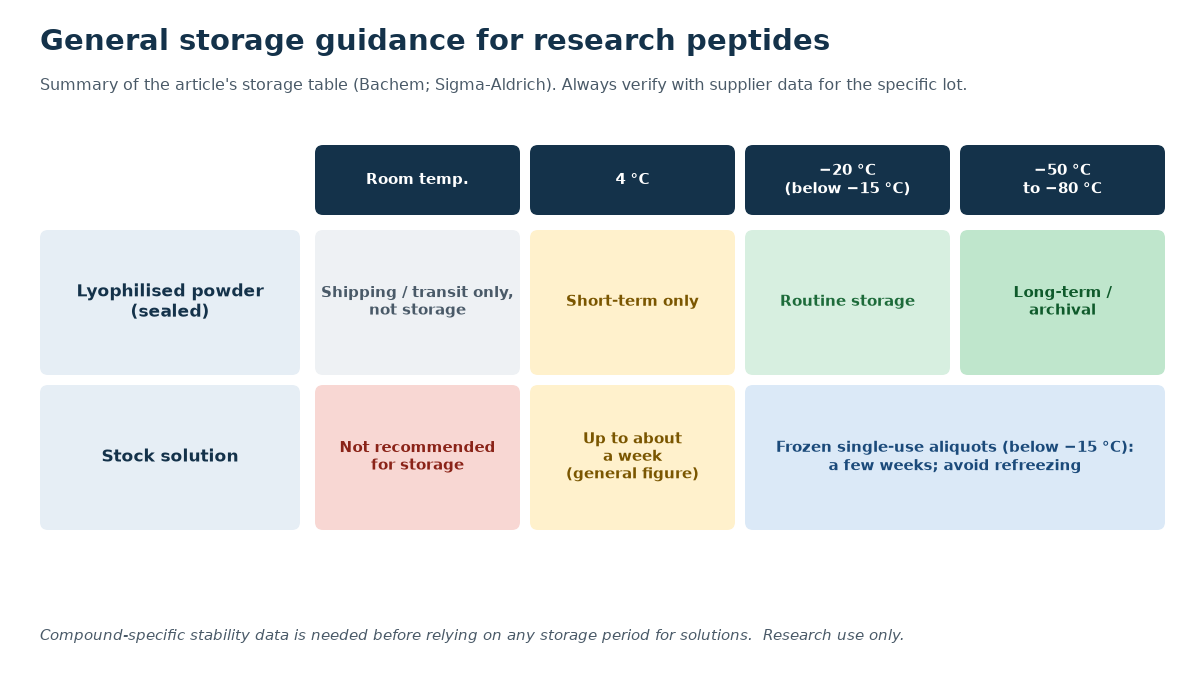
Storage decision table
| Material state | Condition | General guidance | Source | Before relying on it |
|---|---|---|---|---|
| Lyophilised, sealed | 4 °C | Short-term only | Bachem | Verify with supplier data |
| Lyophilised, sealed | −20 °C (below −15 °C) | Routine storage | Bachem; Sigma-Aldrich | Verify with supplier data |
| Lyophilised, sealed | −50 °C to −80 °C | Long-term / archival | Bachem; Sigma-Aldrich | Verify with supplier data |
| Stock solution | Room temperature | Not recommended for storage | Bachem | Prepare fresh |
| Stock solution | 4 °C | Up to about a week as a general figure | Sigma-Aldrich | Compound-specific data needed |
| Stock solution, aliquoted | Frozen below −15 °C | A few weeks; avoid refreezing | Bachem; Sigma-Aldrich | Compound-specific data needed |
Sample log template
A one-line-per-aliquot log answers most “is this still good?” questions about stored research peptides later. Suggested columns:
| Compound | Lot no. | Date received | Storage location / temp | Solvent | Concentration (mg/mL) | Prep date | Aliquot ID | Freeze-thaw count | Initials | Notes |
|---|---|---|---|---|---|---|---|---|---|---|
What should you check when a shipment arrives?
Inspect the parcel and vials promptly, then move the material into the right storage. BodyTechPharma ships within Canada only, uses the handling method described on the product page or at checkout for products with specific storage requirements, and asks that damaged or incorrect orders be reported within 48 hours of delivery (Shipping & Returns). Bachem notes that lyophilised peptides are typically shipped at ambient temperature (Bachem); short transit at room temperature is different from storage at room temperature. Record the receipt date and lot number in your log before the vial goes into the freezer.
FAQ
How should lyophilised research peptides be stored?
Sealed, dry, dark and frozen. Bachem recommends below −15 °C, with −50 °C or lower preferred long-term (Bachem).
Bacteriostatic water or sterile water for research peptides?
It depends on the assay. Bacteriostatic water contains 0.9% or 1.1% benzyl alcohol (DailyMed), which was toxic to cultured retinal cells at the 0.9% concentration in one in-vitro study (PMID 18420195). For cell-based work, use a preservative-free diluent or include a vehicle control.
How long are research peptides stable after reconstitution?
There is no universal answer. Sigma-Aldrich gives up to a week at 4 °C as a general figure; Bachem says frozen solutions may be kept for a few weeks and advises against long-term storage in solution. Confirm with compound-specific data.
Does freeze-thaw damage research peptides?
Repeated cycles are best avoided. Bachem and Sigma-Aldrich both recommend freezing single-use aliquots (Bachem; Sigma-Aldrich).
Why let a vial warm up before opening?
Peptides tend to be hygroscopic. Opening a cold vial pulls moisture onto the powder, which lowers peptide content and may reduce stability (Bachem).
Should research peptides be shaken?
Swirl gently instead. Vigorous agitation has been shown to promote aggregation in some proteins, such as insulin (PMID 19891974). Bachem suggests brief sonication for stubborn particles but warns against excessive warming (Bachem).
Can peptide solutions be stored at room temperature?
No. Bachem advises against storing peptides in solution beyond the short term and recommends frozen aliquots (Bachem).
Methodology
Sources: manufacturer technical guides (Bachem, Sigma-Aldrich), regulator and standards documents (FDA/ICH Q5C, Joint Commission, DailyMed product label), and peer-reviewed studies and reviews indexed in PubMed. Searched Oct 14, 2026. In-vitro findings are labelled as such and do not establish effects in people or animals. No vendor marketing used as evidence.
Research use only. All BodyTechPharma materials are supplied strictly for in-vitro laboratory and research use. They are not medicines, supplements or therapeutic goods, are not for human or animal consumption, and are not authorized by Health Canada for any clinical use. Nothing in this article is medical advice or guidance for use in or on a person or animal.