
Laboratory Research Evidence: 24 Essential Checks for Reliable Health Science

Laboratory research evidence quality depends on validated methods, controls, transparent analysis and conclusions that match the data. This November 5 research guide explains how to evaluate laboratory, animal and clinical findings without confusing an experimental signal with an approved medical treatment.
Why November 5 is a useful day to examine laboratory evidence
November 5 offers an opportunity to examine the research practices that make health claims trustworthy. In a period when headlines travel faster than full scientific papers, a laboratory result is frequently presented as if it were a clinical conclusion. Those are different stages of evidence. A cell experiment may identify a pathway, an animal model may test a biological hypothesis, and a human trial may estimate effects in a defined population. Each stage contributes knowledge but also introduces limits. A responsible review starts by identifying exactly what was measured, how the samples were selected, and whether the methods can support the claim being made. Researchers must also distinguish an interesting finding from one that has been reproduced independently. This article presents an evidence-quality framework for laboratory and clinical research, with examples relevant to metabolic science, peptide investigations, and Canadian regulatory questions.
Begin with a clearly defined question
A strong experiment begins with a question narrow enough to be tested. Asking whether a compound improves health is too broad without defining the population, intervention, comparator, outcome, and observation period. In laboratory research, the question may concern binding affinity, molecular stability, cell signalling, or an analytical method. In clinical research, it may concern a patient outcome or safety endpoint. These questions require different designs. A study can be technically excellent while still answering a question that is less clinically important than its promotional summary suggests. Readers should examine the stated hypothesis before looking at the results. If an experiment measured a biochemical marker, the conclusion should describe that marker rather than claim improved longevity, recovery, or disease prevention. Clear questions are the foundation of proportionate interpretation.
Why control groups matter
A control group helps investigators distinguish the effect of an intervention from changes that might occur without it. The appropriate control depends on the experiment. Laboratory controls may check background signals, reagent contamination, assay performance, or the effects of a vehicle solution. Clinical studies may use placebo, usual care, or an active comparator when ethically appropriate. A poorly chosen control can make an intervention appear more impressive than it is. Controls should be treated similarly to experimental samples except for the factor being studied. Investigators also need to report whether controls were included in each experimental run and whether unexpected results led to exclusions. A figure showing a large difference means little if readers cannot understand what the comparison represents. Good controls make an inference possible; they do not automatically prove it is correct.
Randomization and selection bias
Randomization helps distribute measured and unmeasured participant characteristics across treatment groups in clinical trials. In laboratory work, randomizing sample order or allocation can also reduce systematic effects from equipment, time, or handling. Randomization does not guarantee that small groups will be identical, and its benefits can be undermined by poor implementation. Investigators should explain how allocation sequences were generated and whether assignment was concealed when relevant. Selection bias can occur before an experiment begins if the chosen samples are not representative of the intended population. For example, results from one cell line may not generalize to different tissues or to whole organisms. Similarly, a trial of carefully screened volunteers may not predict outcomes in people with multiple medical conditions. Transparent recruitment and allocation methods help readers judge where conclusions apply.
Blinding and measurement expectations
Blinding reduces the chance that expectations influence how an experiment is conducted or assessed. In clinical trials, participants, clinicians, or outcome assessors may be blinded depending on the design. In laboratory research, analysts can sometimes be blinded to sample identities. Not every experiment can be fully blinded, but investigators should describe what was feasible and how bias was managed. Subjective outcomes are especially sensitive to expectations, while automated measurements may still be affected by decisions about thresholds or exclusions. A study without blinding is not necessarily useless; it simply requires careful interpretation. Readers should avoid treating a polished graph as proof that the analysis was objective. The decisions that produced the graph matter, including which observations were included and how measurements were processed.
Sample size and statistical power
Small studies can be useful for feasibility and early hypothesis testing, but they may provide imprecise estimates. A statistically significant result from a small sample can still be unstable, especially when many outcomes were examined. Power calculations depend on assumptions about effect size, variability, and the desired level of confidence. Those assumptions should be reported rather than hidden. Larger samples can improve precision, but they cannot compensate for systematic bias or poor measurement. Laboratory studies also need to distinguish technical replicates from independent biological replicates. Repeating a measurement on the same sample does not create new independent biological observations. Confusing those categories can make results appear more certain than they are. Readers should look for the actual number of independent units and for confidence intervals that show the plausible range of effects.
The difference between significance and importance
A p-value addresses a statistical question under a specified model; it does not measure the probability that a scientific claim is true. Statistical significance also does not establish that a result is large enough to matter clinically. With a very large sample, a small difference can reach a conventional threshold while having limited practical relevance. Conversely, a smaller study may produce an uncertain estimate of a potentially important effect. Researchers should report effect sizes, uncertainty intervals, and the context needed to judge importance. Clinical outcomes may be more meaningful than small changes in a surrogate marker. When reading research, ask what the result means in ordinary units and how it compares with the baseline risk or value. The scientific interpretation should not depend entirely on whether one number falls just above or below a threshold.
Multiple testing and selective reporting
A study that examines many outcomes has more opportunities to find apparently significant differences by chance. This does not make exploratory research invalid, but it changes how confidently findings should be interpreted. Investigators may use statistical adjustments, hierarchical testing plans, or clear labels distinguishing primary from exploratory analyses. Preregistration can document planned outcomes before results are known. Selective reporting occurs when only favorable comparisons are highlighted while neutral or unfavorable results receive little attention. Readers should compare published reports with protocols and trial registry entries when available. A visually striking secondary finding should not displace the primary outcome without explanation. Scientific credibility improves when researchers show the full pattern of results, including uncertainty and findings that do not support the initial hypothesis.
Replication and reproducibility
Replication asks whether a finding can be observed again under appropriate conditions, while reproducibility often concerns whether the same data and methods yield the reported analysis. Both are important, but they address different weaknesses. A result may be computationally reproducible yet depend on a biased sample. Another result may be biologically robust but difficult to reproduce because essential experimental details were omitted. Researchers can strengthen their work through documented protocols, versioned analysis code, clear reagent identification, and access to suitable data where ethical and legal conditions permit. Independent confirmation is especially valuable for surprising or commercially important findings. A single positive experiment should be treated as one contribution to a larger evidence base, not as a final verdict.
Analytical validation in peptide research
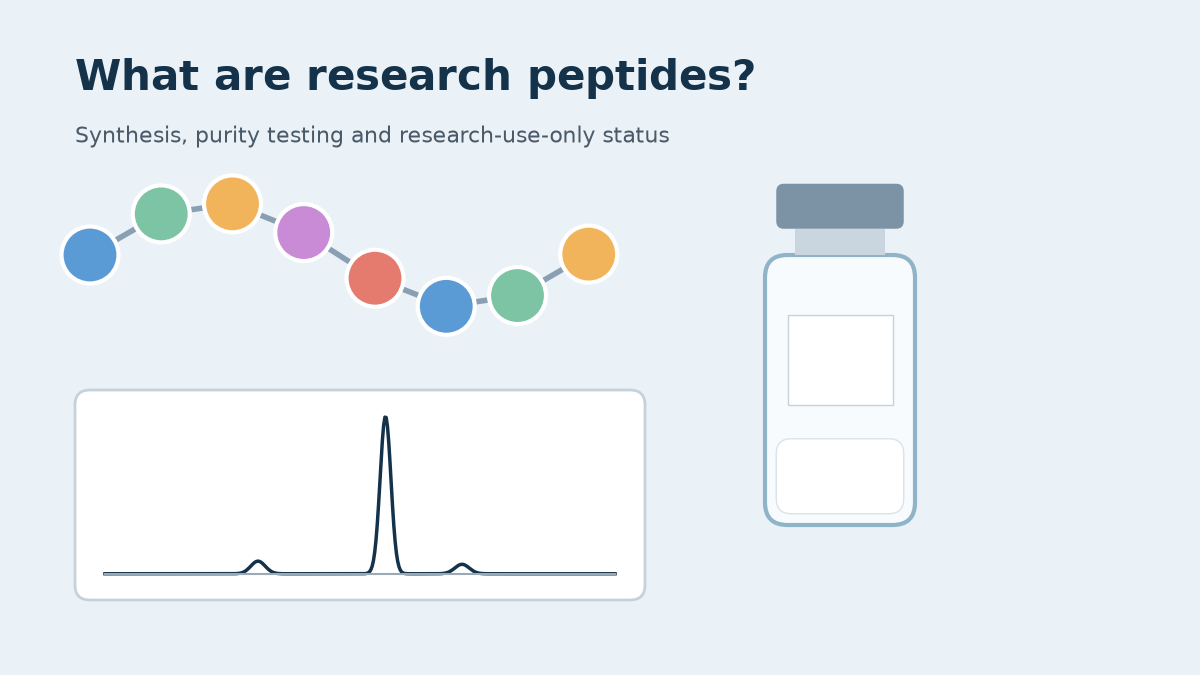
Peptide-related laboratory studies often depend on the identity and quality of the material being tested. Analytical methods may be used to examine molecular mass, chromatographic behavior, purity, degradation, and other characteristics. No single test establishes every property. A chromatogram showing one prominent peak does not automatically prove the absence of all relevant impurities or confirm the exact quantity of active material. Method validation should consider specificity, accuracy, precision, detection limits, and suitability for the intended use. Reference standards and controls are essential for meaningful comparisons. The quality of an analytical result also depends on sample handling and documentation. A seller’s certificate or marketing statement is not equivalent to an independently verified, comprehensive quality system. Laboratory evidence should describe the tested material and the methods actually used.
Identity, purity, and potency are distinct
Identity addresses what a substance is. Purity concerns the proportion of measured material attributable to the intended substance under a specified analytical method. Potency refers to biological activity or strength in an appropriate context. These concepts are related but not interchangeable. A material can have a strong identity result while containing impurities, and a high purity estimate does not automatically establish biological activity. Water content, counterions, residual solvents, or degradation products may also affect interpretation. Researchers should report the basis of quantitative measurements and avoid presenting a single percentage as a universal quality guarantee. This distinction is particularly important when discussing investigational peptides, where the material used in a controlled study may differ from independently marketed laboratory products. Conclusions must remain tied to the specific tested preparation.
Storage and stability as experimental variables
The condition of a sample can change between preparation and analysis. Temperature, light, moisture, oxygen exposure, container materials, and time may affect stability depending on the compound. An experiment that does not document handling may inadvertently compare samples with different degradation histories. Stability studies require validated analytical methods and defined conditions. Researchers should avoid assuming that one storage rule applies to every peptide or formulation. A lyophilized sample and a prepared solution may behave differently, but the actual stability profile must be established for the specific material. Batch records and chain-of-custody information can help explain unexpected findings. Good laboratory practice treats storage and transport as part of the experiment, not as incidental details omitted from the methods section.
Cell models and their limitations
Cell culture can reveal molecular mechanisms and generate hypotheses efficiently. Yet cultured cells do not reproduce the full complexity of organs, immune responses, metabolism, or behavior. A response observed at a particular concentration in one cell line may not occur at comparable exposure in a living organism. Cell lines can also change with passage number, contamination, and culture conditions. Researchers should authenticate models when appropriate and monitor for contamination. Results become more persuasive when supported by complementary methods or different relevant models. Claims about human treatment, athletic recovery, or disease prevention require evidence beyond an isolated cell experiment. The right conclusion from a cell study may be that a pathway deserves further investigation, not that a clinical benefit has been demonstrated.
Animal models and translation
Animal studies can examine whole-organism physiology and interactions that cell systems cannot capture. However, species differ in metabolism, receptor expression, immune function, and disease characteristics. An effect in a rodent model does not guarantee the same magnitude or direction in humans. Study quality depends on appropriate controls, randomization, blinding, sample-size justification, and welfare standards. Housing conditions and sex-related differences may influence outcomes. Investigators should report these details so readers can assess reproducibility and relevance. Translation to human medicine requires additional evidence, including safety and pharmacology. A responsible research summary describes animal findings accurately without converting them into dosing instructions or treatment claims for people.
Human trials and endpoint hierarchy
Human studies vary from early pharmacology investigations to large trials designed to test clinical outcomes. Early-phase research may focus on exposure, tolerability, and preliminary signals. Later trials may evaluate prespecified benefits and risks in defined populations. Trial phase alone does not prove efficacy or authorization. Readers should examine the primary endpoint, comparator, participant selection, follow-up, and analysis population. A change in a biomarker may support a mechanism without establishing a reduction in hospitalization, disability, or mortality. Safety monitoring is integral to the result, not a secondary marketing concern. Study conclusions should remain specific to the population and intervention tested. A treatment’s eventual regulatory status requires separate verification through the appropriate authority.
Adverse events and missing information
A study reporting favorable efficacy results may still have important limitations in its safety evidence. Researchers track adverse events, serious events, withdrawals, and laboratory abnormalities, but the ability to detect uncommon harms depends on sample size and duration. Missing data can introduce bias if participants who discontinue differ from those who remain. Investigators should explain how missing outcomes were handled and whether sensitivity analyses support the conclusions. Readers should distinguish absence of observed harm from proof of safety. Short studies are especially limited for outcomes that emerge slowly. Balanced reporting presents the frequency and severity of adverse events alongside the measured benefits and avoids descriptions such as risk-free or universally tolerated.
Observational studies and confounding
Observational research can reveal patterns in large populations and provide information that randomized trials may not capture. However, people exposed to a factor may differ systematically from those who are not. Age, income, baseline health, activity, medication use, and healthcare access can all confound associations. Statistical adjustment can reduce some bias but cannot guarantee that every relevant difference has been measured. Reverse causation is another concern when an emerging illness changes behavior before diagnosis. Longitudinal designs and sensitivity analyses can strengthen inference, but causal language still requires care. A responsible article distinguishes an association from a demonstrated intervention effect. This is particularly important when social media presents a cohort finding as proof that a particular compound, diet, or behavior prevents disease.
Systematic reviews and evidence synthesis
A systematic review can summarize multiple studies using a defined search and appraisal process. Its value depends on the quality and comparability of the included evidence. Combining poorly designed studies does not automatically produce a reliable conclusion. Meta-analysis may estimate an overall effect, but substantial differences in populations, interventions, or outcomes can limit interpretability. Reviewers should assess risk of bias, heterogeneity, publication bias, and certainty of evidence. A review published several years earlier may also miss important newer trials. Readers should not assume that the presence of a pooled estimate settles every question. The most useful syntheses explain where results are consistent, where uncertainty remains, and which populations have not been adequately studied.
Research ethics and conflicts of interest
Scientific research involves responsibilities to participants, animals, communities, and the integrity of the evidence. Human studies require appropriate oversight and informed consent. Animal studies should follow applicable welfare standards and justify their design. Funding sources and conflicts of interest should be disclosed because they can influence priorities, study design, and reporting. Disclosure does not automatically invalidate findings, just as independent funding does not guarantee quality. The appropriate response is transparent methods, independent scrutiny, and access to sufficient information for critical appraisal. Ethical communication also avoids overstating findings to encourage unsafe experimentation. Scientific credibility depends on both how evidence is produced and how it is represented to readers.
Canadian regulatory distinctions
Canadian readers should distinguish laboratory research, authorized clinical trials, and medicines approved for routine use. Health Canada assesses drug submissions through regulatory processes that are separate from publication in a journal or registration of a trial. A compound can be actively investigated without being authorized for sale as a treatment. Approval elsewhere does not automatically establish Canadian approval. Labels such as research grade or laboratory use do not substitute for the manufacturing, clinical, and regulatory requirements applicable to medicines. Because status can change, readers should consult current official Canadian resources when evaluating a specific product. This distinction is essential for interpreting emerging peptide and metabolic research without confusing scientific interest with medical authorization.
How to evaluate a viral research claim
Begin by locating the primary source and its date. Determine whether the claim comes from a laboratory experiment, animal study, clinical trial, conference abstract, press release, or peer-reviewed report. Identify the population, comparator, endpoint, and sample size. Look for absolute results and uncertainty rather than relying on a dramatic percentage. Ask whether the finding was prespecified, whether harms were reported, and whether independent groups have replicated it. A social media chart may omit the denominator or show only a favorable subgroup. If a claim involves an investigational product, verify regulatory status separately. The strongest response to a sensational headline is a precise explanation of what was measured and what remains unknown.
A practical evidence-quality checklist
A reliable research assessment can be organized around several questions. Is the hypothesis specific? Were the intervention and comparator clearly defined? Were controls appropriate? Were allocation and analysis methods documented? Is the number of independent samples clear? Were outcomes prespecified and uncertainty reported? Could confounding or measurement error explain the result? Were adverse events and missing data addressed? Is the tested material adequately characterized? Has the finding been independently confirmed? Finally, does the conclusion stay within the limits of the study design? These questions do not replace specialist review, but they help readers avoid treating an appealing mechanism or isolated result as established clinical evidence.
Conclusion
Scientific progress depends on experiments that can be interpreted, challenged, and repeated. Strong research begins with a clear question, uses appropriate controls, documents methods, reports uncertainty, and separates laboratory observations from clinical conclusions. Analytical quality, sample stability, statistical design, and transparent safety reporting all matter. In peptide and metabolic research, the distinction between an investigational compound and an authorized medicine is especially important. Readers are best served by evidence summaries that explain both findings and limitations rather than promising more than a study demonstrates. Careful interpretation is not an obstacle to innovation; it is what makes trustworthy innovation possible.
Frequently asked questions
Does a laboratory result prove a treatment works in humans?
No. Laboratory findings can support hypotheses, but human clinical outcomes require appropriate human research.
What is the difference between purity and potency?
Purity concerns composition under a defined analytical method, while potency concerns biological activity or strength.
Why are control groups important?
They help distinguish intervention effects from background changes, handling effects and other explanations.
Does statistical significance mean a benefit is clinically important?
Not necessarily. Effect size, uncertainty and the outcome’s real-world importance must also be considered.
Does a clinical trial mean a drug is approved in Canada?
No. Trial authorization and routine marketing authorization are separate regulatory matters.
For laboratory research use only. Not for human consumption.